Philosophical instruments
Experiments in thinking with AI.
Each instrument begins with a philosophical text, image, or question and gives you something to change or compare. See what follows, then return to the source to ask what the scene shows—and what it leaves out.
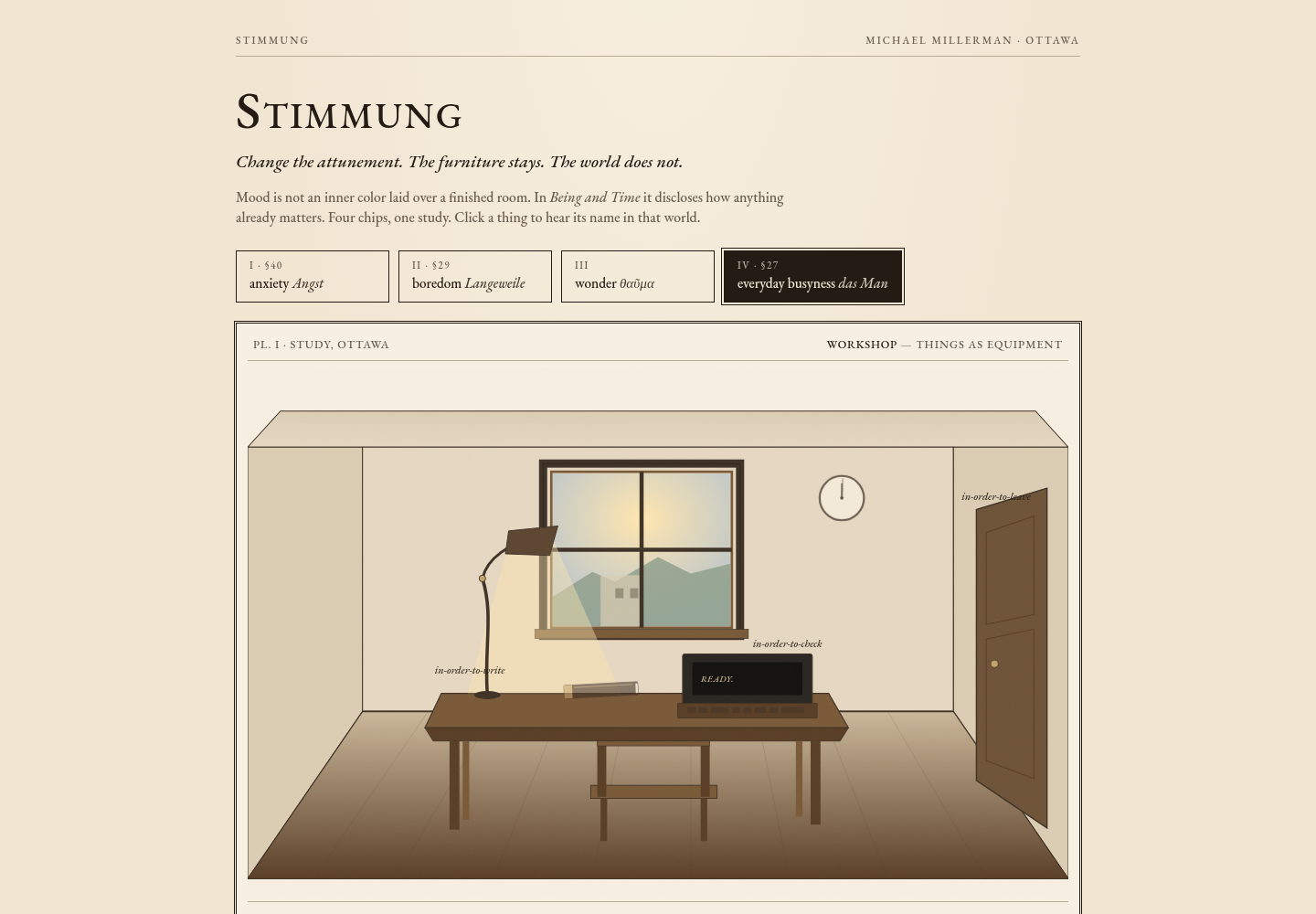
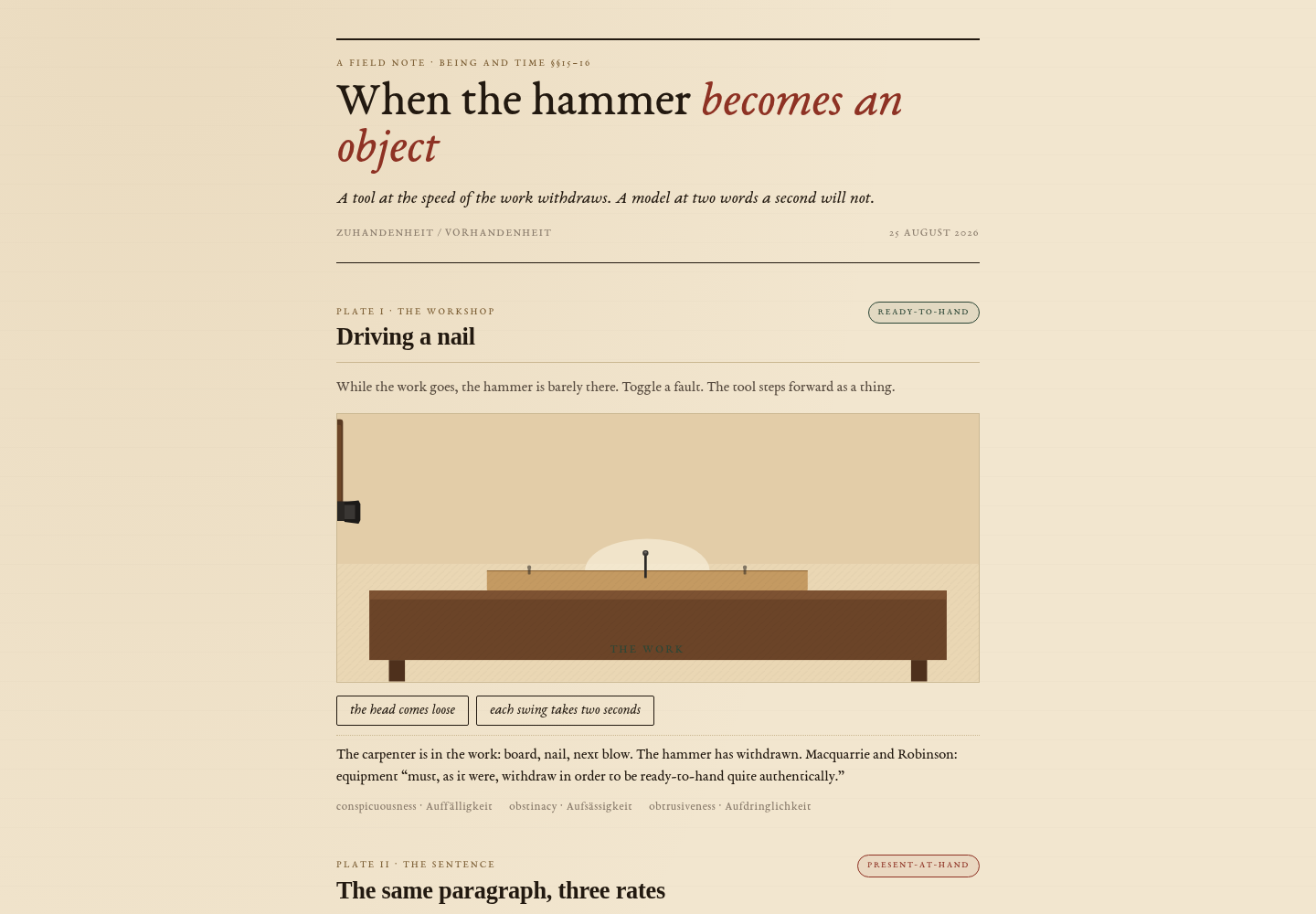
In one, the same room looks different in anxiety, boredom, and wonder. In another, a hammer disappears into the work until it slows down or breaks.
Instrument
Being and Time §29
 Enter the instrument
Featured
Stimmung
For Heidegger, a mood is how the world shows up in the first place. Switch the mood, and the same room with the same furniture means something different.
In everyday absorption, the room is organized around what you are doing: the desk, the lamp, the way to the door.
AI & philosophy
AI as a philosophical object
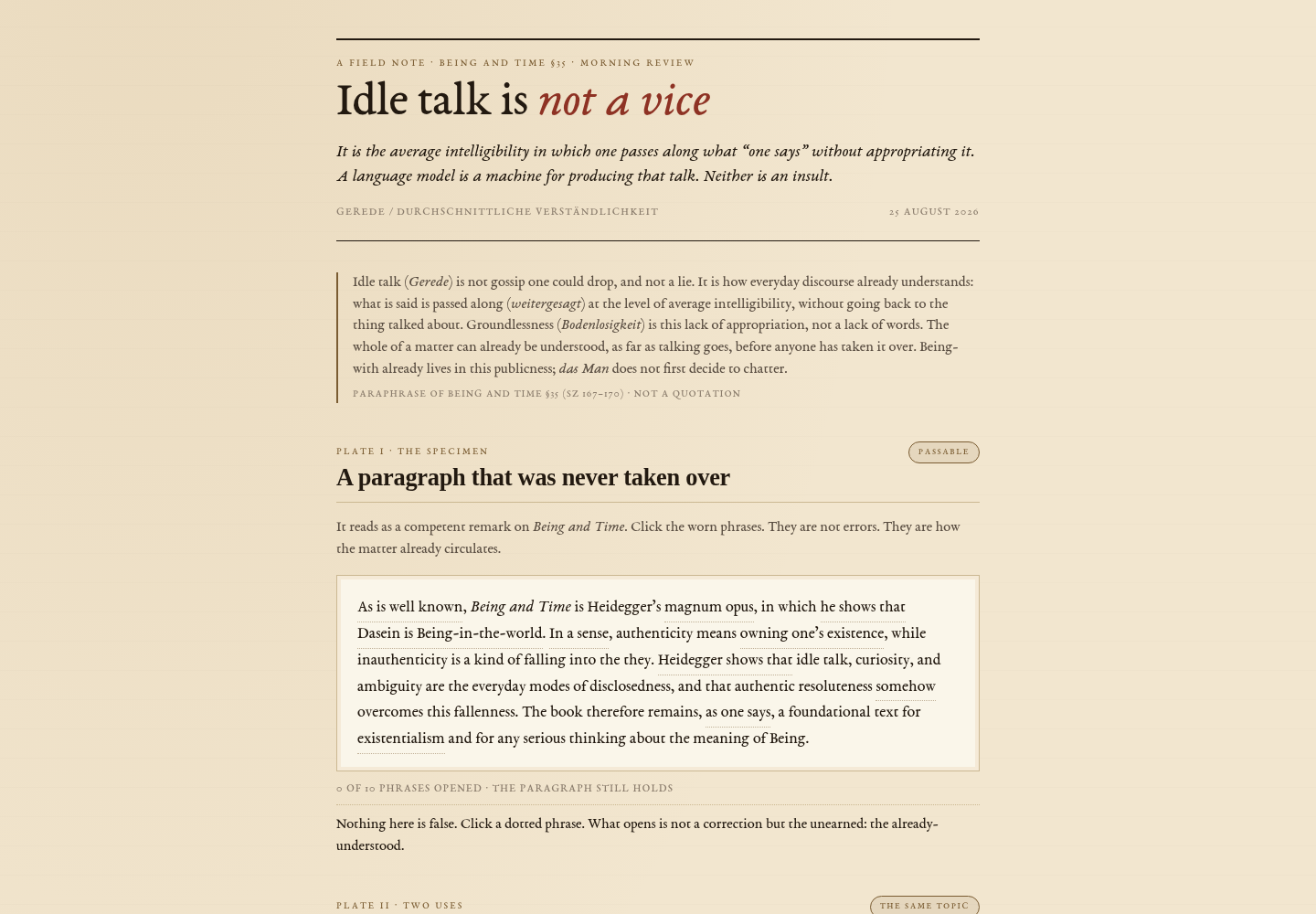
Some instruments treat language models themselves as the thing to think about. Heidegger and Kojève help ask what their fluency shows, what it covers over, and why people defer to it.
Leaping in, leaping ahead
Heidegger distinguishes help that does the thing for you from help that gives your own care back to you. Watch both, then ask which one your AI is doing.
EnterAuthority without reaction
Kojève defines authority as acting on someone without their reacting, though they could. Place a language model among his four types and see which one it can’t claim.
EnterQueen of the sciences
Philosophy was once queen of the sciences. Five pictures follow how STEM displaced it and how AI brings it back to the middle, from a twelfth-century rose window to the language model.
EnterThe collection
The instruments
The collection moves between passages, images, and questions. Each work gives you something to change or compare, then invites you back to its source. More visualizers at Millerman School Some companion projects have their own sites. Links marked ↗ take you there.
Plato’s Cave
A free interactive journey through the allegory, with a complete audio lesson and short exercises in explaining it and reading Plato closely.
The Divided Line
Plato divides knowing into four kinds along a single line. Move from a shadow to the thing that casts it, then to a mathematical argument, then to a question about first principles.
Enter the divided line
When the hammer becomes conspicuous
While you work, you don’t notice the hammer. Slow it down or break it, and it comes back into view.
Enter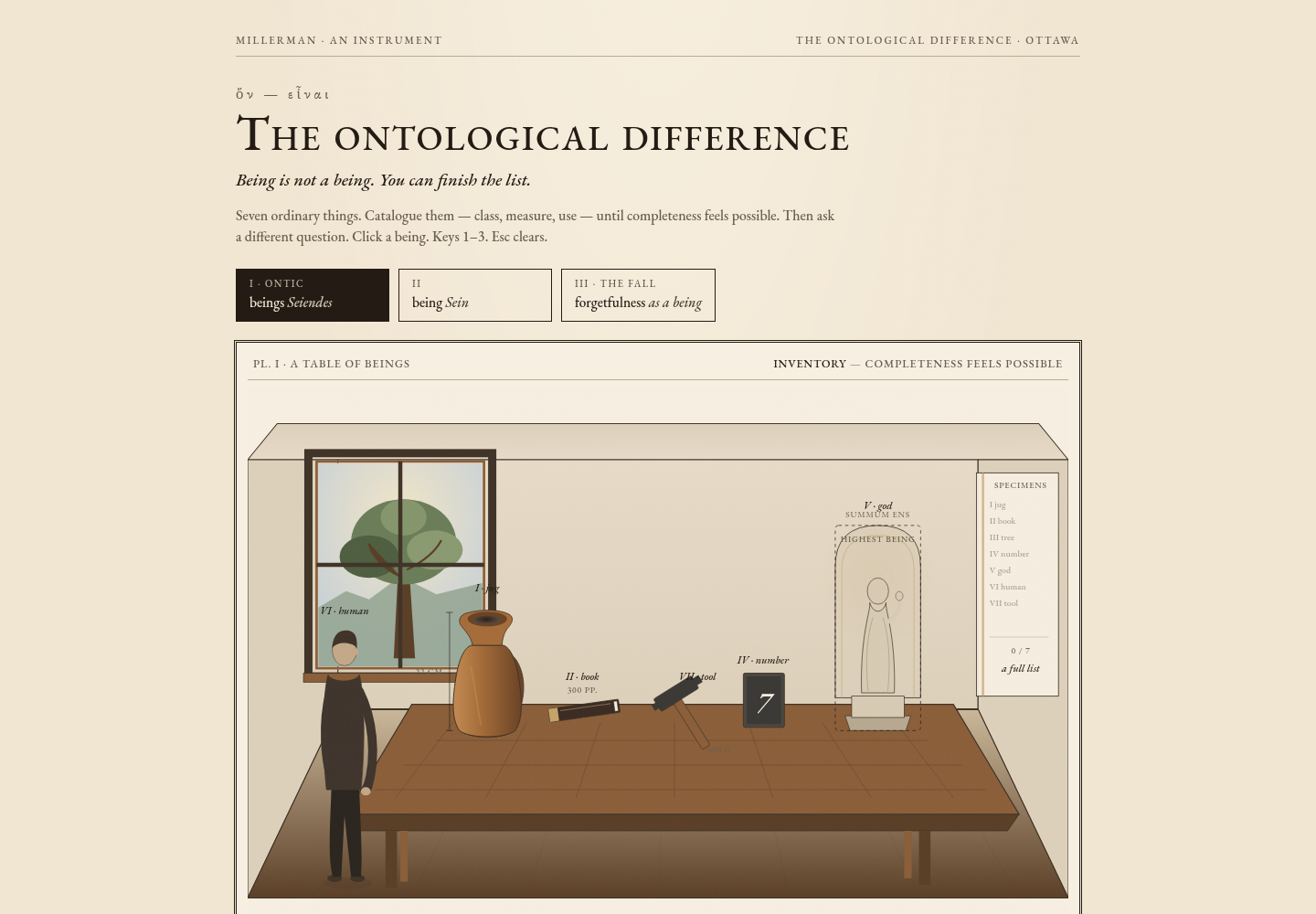
The Ontological Difference
List every being in the room and you still haven’t said what it means for them to be. Heidegger calls that gap the ontological difference.
Enter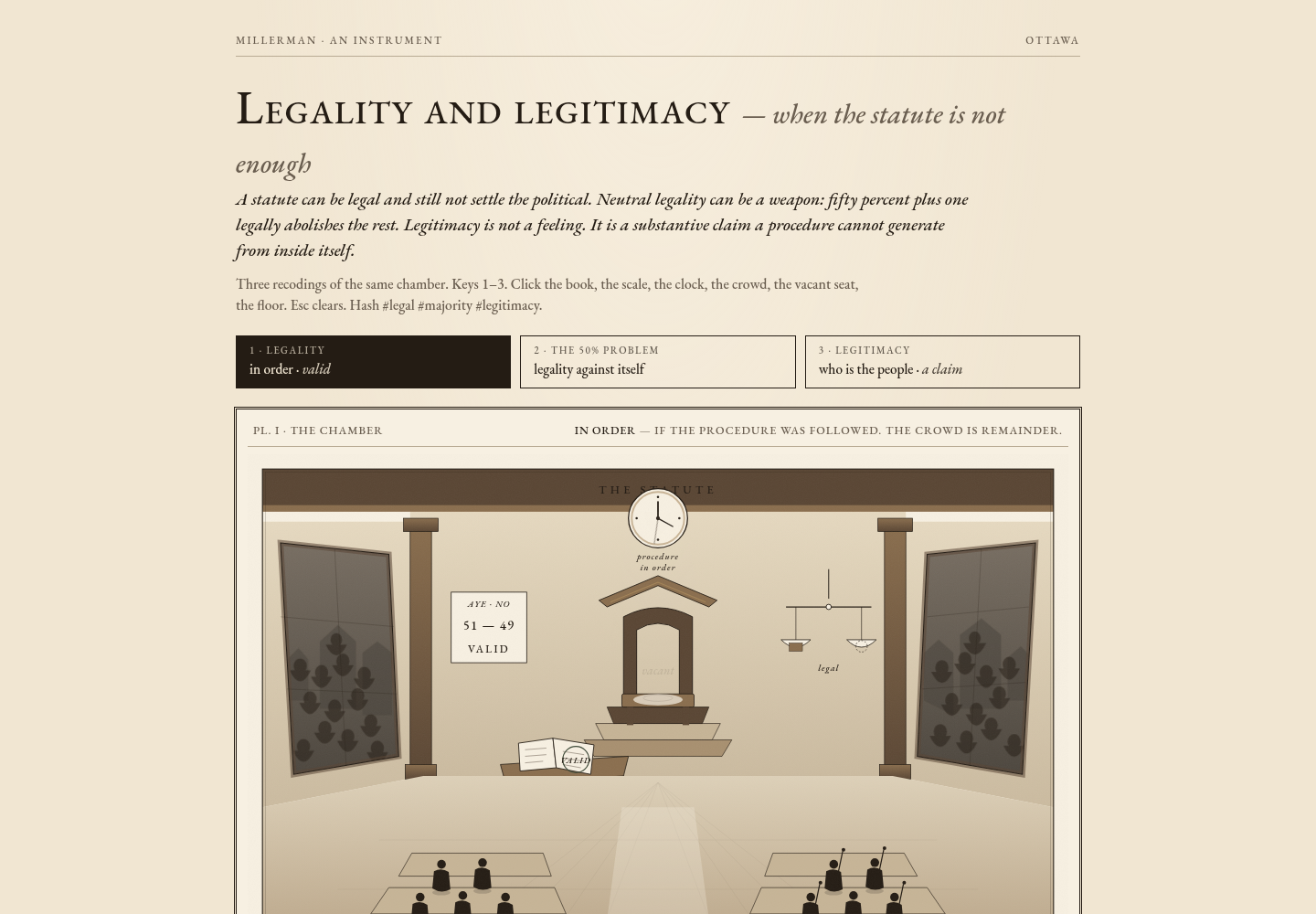
Legality and Legitimacy
Run a parliament where every vote is counted correctly. Schmitt’s worry is that a majority that wins by the rules can then use them to lock everyone else out.
EnterThe method
How these are made
Some distinctions are easier to see when you can operate them. A delay can make a tool conspicuous, and a single switch can show the same scene in two ways. Part of the argument is in what the page does when you use it.
I choose the texts, decide what each instrument should show, and approve the final form. AI models write most of the code and help with variations and prototypes. The collection is provisional, and instruments may be revised, replaced, or retired.
AI helps make these pages, and in some of them it is also what we are thinking about. That does not make the page authoritative: an instrument is an interpretation to test against its sources, not a substitute for reading them.
What makes an instrument
Read
Find the passage, image, or question the instrument starts from.
Operate
Change a condition and notice what comes into view, and what recedes.
Check
Return to the source. Ask what the scene clarifies, and where it simplifies or goes beyond the argument.
Workshop archive
Earlier instruments and ones still in progress. They stay up while the collection is revised.
From the workshop
Try the free lectures.
Thirty days of sample lectures from Millerman School. You sign up with your email.